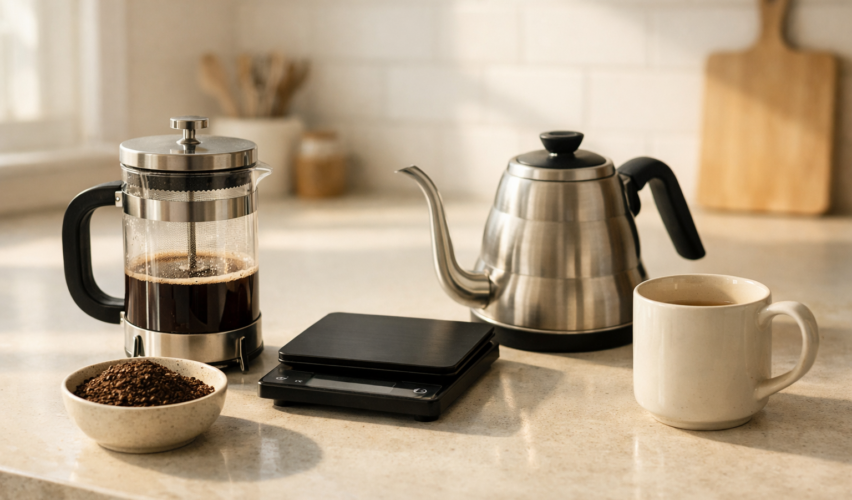
French press coffee is a full-immersion brew: grounds steep directly in hot water, then a mesh filter separates the liquid from the grounds when you plunge. The method is widely known for producing a bold, full-bodied cup, because the coffee stays in contact with water for several minutes and paper filtration isn’t used. This is described in the National Coffee Association’s French press overview and echoed by step-by-step brew guides from roasters like Stumptown and PT’s Coffee.
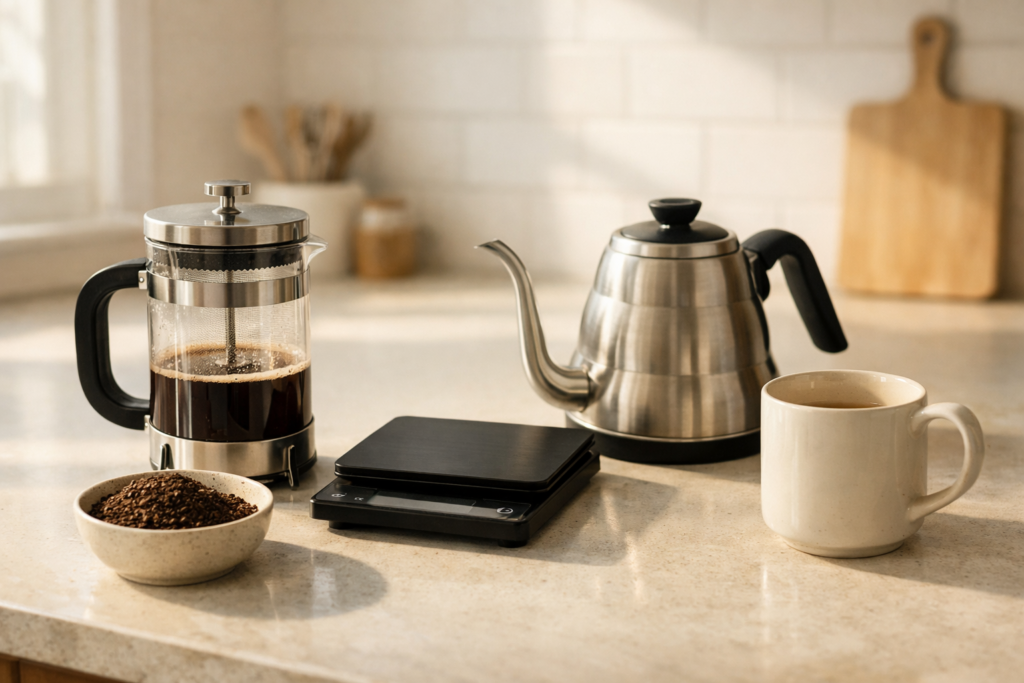
What you’ll need
- French press
- Kettle (a thermometer helps if your kettle doesn’t show temperature)
- Coffee (whole bean + grinder is ideal)
- Scale + timer (strongly recommended for consistency)
The NCA recommends using a scale for repeatable results, and both Stumptown and PT’s Coffee also build their recipes around weighed coffee and water.
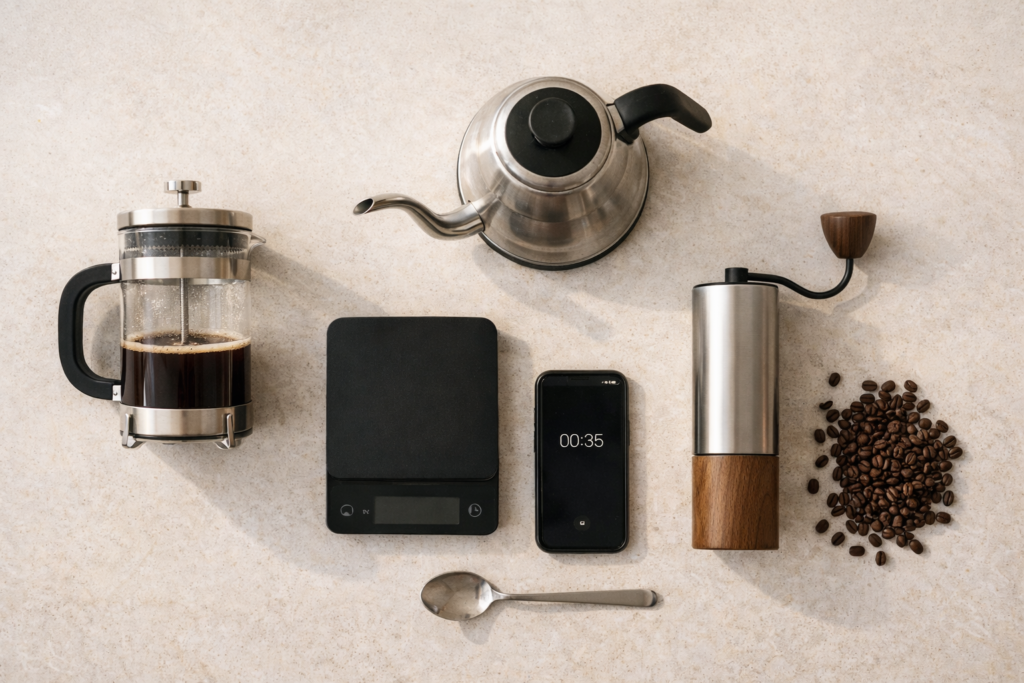
The reliable “starter recipe”
A strong, dependable starting point is:
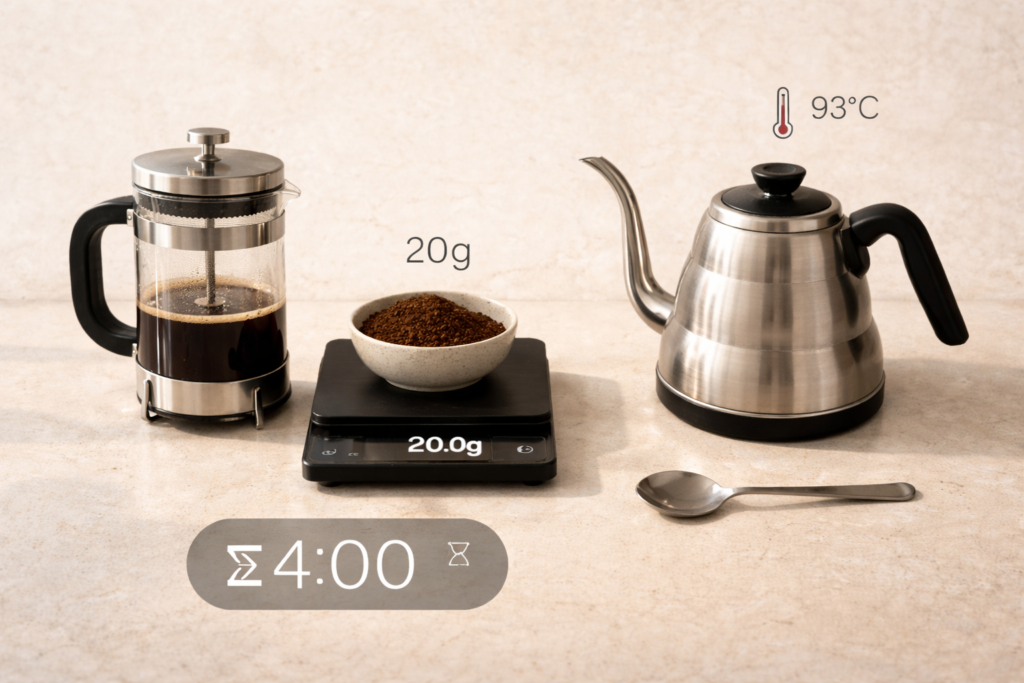
- Ratio: 1:15 (example: 20 g coffee to 300 g water)
- Water temp: about 90–96°C / 195–205°F
- Steep time: about 4 minutes
- Grind: coarse (rock-salt / breadcrumb-like)
These “quick numbers” align with the National Coffee Association’s French press quick ratios, temperature, and time and are consistent with recipes from PT’s Coffee (1:15, 4 minutes, 195–200°F) and ESPRO (195–205°F and up to 4 minutes).
Brew ratio table (light, medium, strong)
These options stay within the NCA’s commonly recommended French press ratio range and mirror the “start at ~1:15 and adjust” approach used by guides like PT’s Coffee and Stumptown.
| Strength | Ratio (coffee:water) | Example for 300 g water |
| Light | 1:16 | ~19 g coffee |
| Medium | 1:15 | 20 g coffee |
| Strong | 1:13 | ~23 g coffee |
Step-by-step: How to brew French press coffee
1) Preheat the press (recommended)
Rinse the empty press with very hot water, then discard it. Preheating is explicitly recommended by Stumptown and PT’s Coffee, and it helps stabilize brewing temperature as the NCA notes temperature control affects quality.
2) Measure and grind
Start with 20 g coffee for 300 g water (or scale up at 1:15). The NCA’s ratio range (1:10 to 1:16) supports this as a reasonable target, and PT’s Coffee uses 1:15 as its baseline recipe.
Grind coarse—the NCA describes French press grind as “coarse (like rock salt)” and Stumptown recommends coarse, breadcrumb-like grounds.
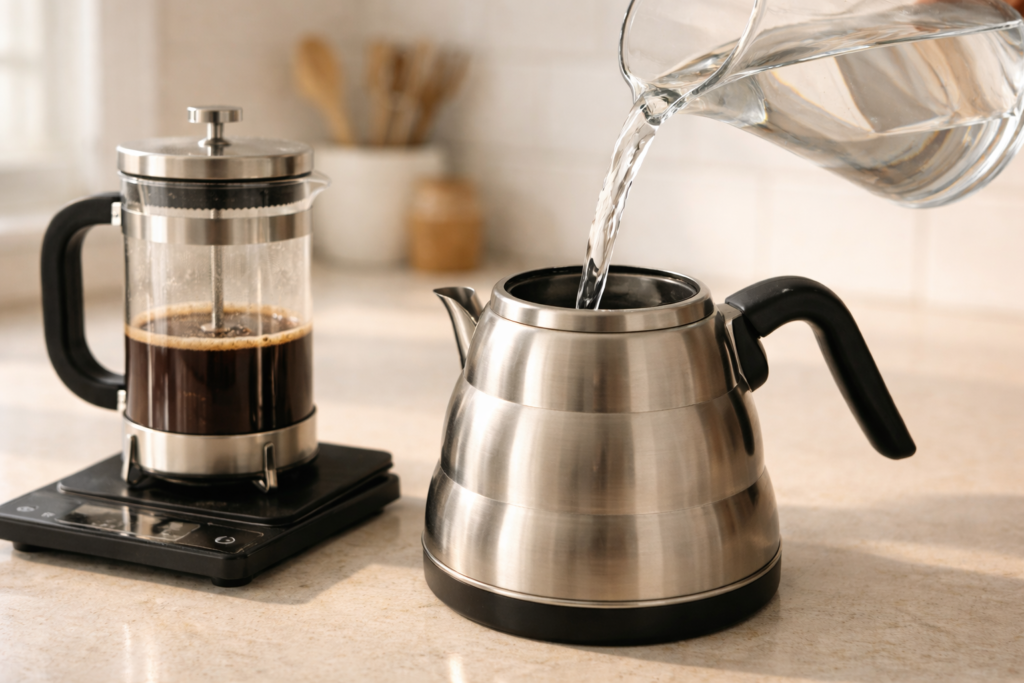
3) Heat water to the right temperature
Bring water to a boil, then let it rest briefly before pouring. The NCA’s step-by-step method calls for boiling then resting ~30 seconds, and ESPRO similarly notes boiling water (212°F) should cool slightly into ~195–205°F.
4) Pour and start the timer
Add grounds to the carafe, pour in the hot water, and start timing right away—this matches the workflow in the NCA’s brewing steps and in PT’s Coffee’s timed recipe.
5) At ~1 minute, break the crust
After about a minute, you’ll often see a floating “crust” of grounds—stir gently to break it. This “crust” step is explicitly described in the NCA’s French press instructions and also in Stumptown’s 1:00 stir step.
6) Steep to ~4 minutes total
Put the lid on with the plunger pulled up, then steep to about 4 minutes total contact time. This is the standard timing in the NCA quick numbers and steps, Stumptown’s “press at 4:00”, and PT’s Coffee’s 4-minute guide.
7) Plunge slowly, then pour right away
Press down gently and steadily, then serve immediately or decant to another container. The NCA warns that coffee left in the press continues brewing and turns bitter, and Stumptown also recommends pouring into a carafe immediately to avoid over-extraction.
AI image — prompt:
Four-panel realistic sequence (no text): (1) adding coarse grounds, (2) pouring hot water, (3) stirring the crust at 1 minute, (4) plunging and pouring into a mug. Clean instructional style.
Water choice: a quick upgrade that matters
Use cold water (filtered if you can) and avoid distilled or softened water, because minerals in water influence extraction and flavor. This guidance appears directly in the NCA’s French press recommendations, and the Specialty Coffee Association explains how dissolved minerals affect extraction and taste (including why mineral-free water behaves differently).
Adjustments for taste (change one variable at a time)
If it tastes bitter or harsh
Try coarser grind, slightly cooler water within the recommended range, or a slightly shorter steep. The NCA links bitter/sour outcomes to grind being too fine (over-extraction), and both Stumptown and ESPRO reinforce the “coarse + controlled time + correct temp” approach to keep extraction in check.
If it tastes weak or watery
Try a slightly finer (still coarse) grind, a slightly higher dose (move from 1:15 toward 1:14), or ensure you’re brewing close to the recommended temperature band. The NCA notes “flat or watery” can come from grind being too coarse (under-extraction), while PT’s Coffee’s 1:15 baseline gives you a reference point to increase dose slightly if needed.
Clean-up: how to keep tomorrow’s coffee from tasting stale
Disassemble and wash the plunger/filter after each use, because trapped grounds and coffee oils can spoil flavor over time. The NCA specifically warns that leftover grounds and coffee oil (“caffeol”) can make the next cup taste bitter, and cleaning guides like JavaPresse’s French press cleaning guide note that oils can turn unpleasant (even rancid) if they’re allowed to build up.
Summary
Start with coarse grounds, ~90–96°C / 195–205°F water, and a 4-minute steep at about 1:15, then plunge slowly and pour immediately. Those targets are consistent across the National Coffee Association’s French press guide and respected brew guides from Stumptown, PT’s Coffee, and ESPRO.