
Putting on a duvet cover is mostly about aligning the corners and keeping the insert from sliding. The steps below work for any size (twin–king) and for most closures (buttons, snaps, zipper, ties).

Before you start: do these 30-second checks
- Match sizes: Make sure your duvet insert and cover are the same size (e.g., queen insert with queen cover). A mismatch is the #1 cause of bunching and shifting (basic bedding sizing guidance: see common size charts like those used by manufacturers and retailers such as The Company Store’s bedding size guide and the Sleep Foundation’s duvet vs. comforter overview).
- Find the “top” of the cover: Many covers have a tag or label sewn into a bottom seam—use it to orient the opening consistently (common manufacturing convention described in care tips from brands and bedding guides like Brooklinen’s duvet cover guide and Parachute’s duvet cover instructions).
- Look for corner ties/loops: If your cover has internal ties and your insert has loops, use them—this is one of the most effective ways to reduce shifting (tie/loop purpose explained in guides like The Company Store’s duvet basics and Parachute’s instructions).

Method 1: The “Inside-Out Burrito” (fastest for most people)
This is the go-to method because it keeps everything aligned and minimizes shaking. It’s widely taught in bedding care guides (examples: Brooklinen and Parachute).
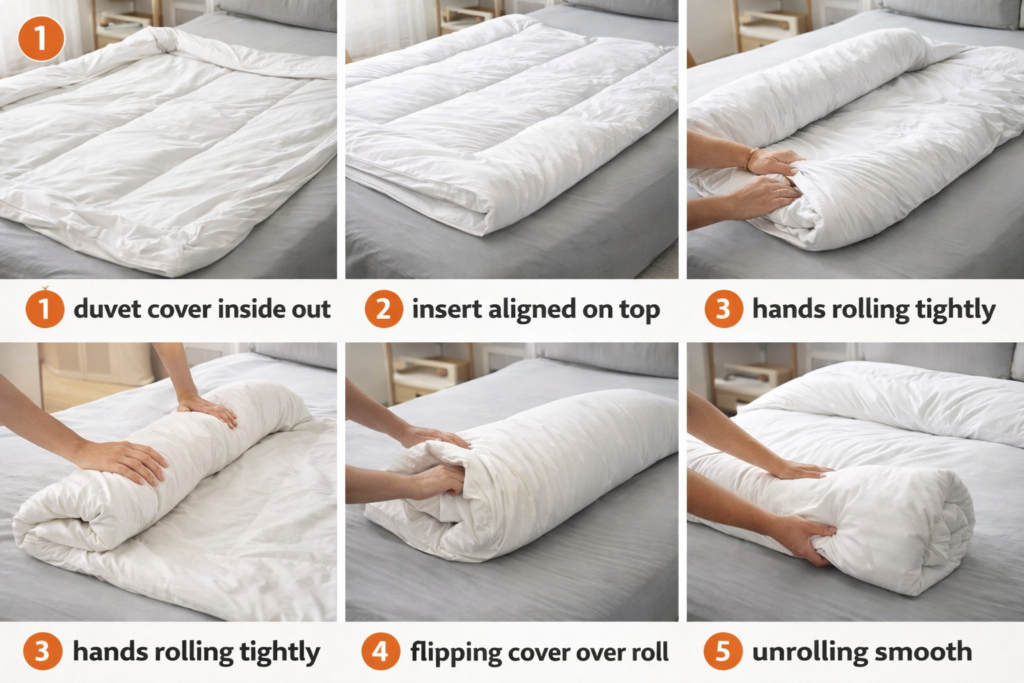
- Turn the duvet cover inside out and lay it flat on the bed with the opening at the foot.
- Place the duvet insert on top of the inside-out cover, aligning the corners.
- Secure corners first:
- Tie the cover’s inner ties to the insert’s loops (if present), as recommended in guides like The Company Store and Parachute.
- Roll both together from the head to the foot like a tight burrito.
- Reach inside the cover opening at the foot, grab the rolled end, and flip the cover right-side-out over the roll.
- Unroll back toward the head and smooth as you go.
- Close the opening (buttons/snaps/zipper).
Pro tip: After unrolling, lift the duvet slightly and give it two small “settling shakes”—too much shaking can reintroduce twisting, but a couple of small shakes helps the fill spread evenly (the “shake to distribute” concept shows up in many how-to guides like Brooklinen and Sleep Foundation bedding care basics).
Method 2: The “Corner Grab + Shake” (best when you’re in a hurry)
This method is classic, but it’s easier if your cover is roomy and your insert isn’t oversized.
- Turn the cover inside out.
- Put your arms inside and grab the two top corners of the cover.
- Still holding the corners, grab the two top corners of the duvet insert.
- Lift everything up and let the insert fall into the cover, then shake gently until it drops into place.
- Lay it down, pull the bottom corners into place, tie corners (if available), and close.
This approach is also described in many bedding brand instructions (e.g., Parachute and The Company Store), but it tends to be messier than the burrito method on king-size duvets.

Method 3: The “Two-Person Team” (best for king size)
If you have a king duvet or limited arm span, teamwork is the cleanest solution.
- Person A holds two top corners; Person B holds the other two corners.
- Align, tie corners, then lift and let the insert settle evenly.
- Lay flat, smooth, and close.
Even bedding brands often suggest a second set of hands for larger sizes in their how-to guidance (see size/handling mentions in guides like Brooklinen and The Company Store).

How to keep the duvet from bunching or sliding later
- Use corner ties/loops whenever possible; they’re designed specifically to prevent shifting (explained in The Company Store’s duvet cover guide and Parachute’s instructions).
- If your insert has no loops, you can add sew-on duvet tabs or use duvet grippers/clips—a common bedding hack mentioned in practical guides and retailer FAQs (general examples: Sleep Foundation bedding tips and brand guides like Brooklinen).
- Choose a cover fabric with a bit of “grip” (like cotton percale with texture) if your insert tends to slide; slippery fabrics can move more (fabric behavior basics commonly discussed in bedding material overviews such as the Sleep Foundation’s bedding materials articles).

Troubleshooting (quick fixes)
- One corner is empty: Open the closure, reach to the empty corner, and pull the insert corner in; then smooth diagonally across the duvet to distribute fill (practical fix often described in how-to guides like Parachute).
- Twist in the middle: Use the burrito method instead; it prevents the internal rotation that causes twisting (method benefits shown in Brooklinen’s guide).
- Buttons pop open: Don’t overstuff; confirm the insert isn’t larger than the cover and button from the center outward to reduce strain (sizing/fit rationale supported by size guidance like The Company Store’s bedding size guide).
Summary
For the easiest, neatest result, use the inside-out burrito method: align corners, tie them if you can, roll, flip, and unroll. If you’re in a rush, do the corner grab + shake, and for king sizes, two people makes it painless. Corner ties (or added tabs/clips) are the best long-term fix to stop shifting.