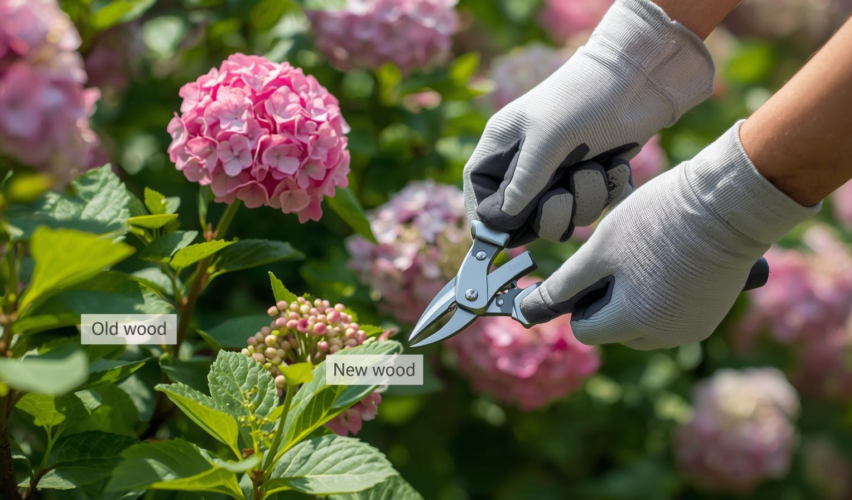
Hydrangeas are “easy” to prune once you know one thing: some bloom on last year’s stems (“old wood”), and others bloom on new growth made this season (“new wood”). That difference determines when you can prune without sacrificing flowers, as explained by the Royal Horticultural Society’s hydrangea pruning guide, the University of Minnesota Extension, and N.C. Cooperative Extension resources.
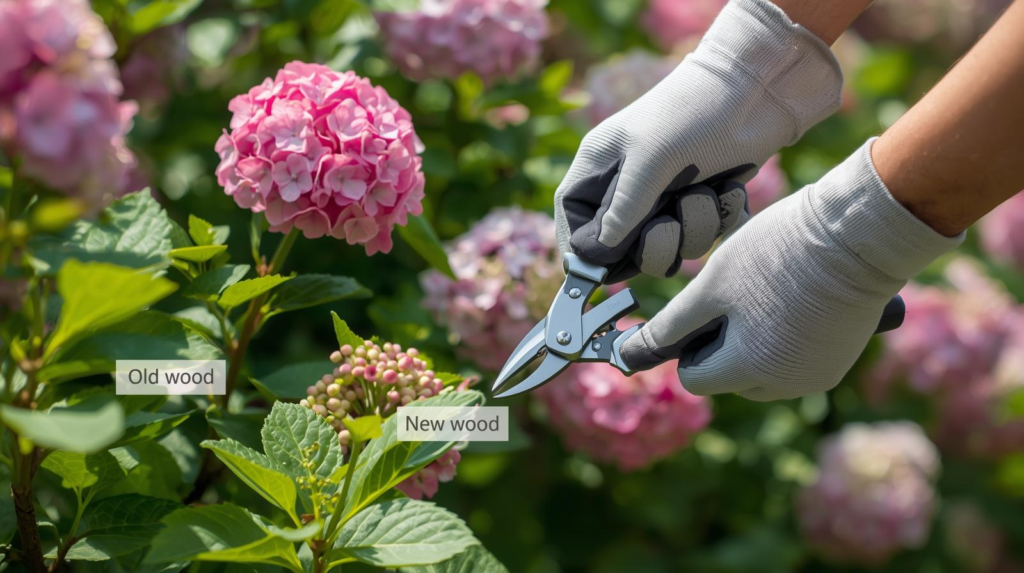
A quick pruning cheat sheet (timing by type)
Use this as your “don’t cut the buds” map, based on guidance from N.C. Cooperative Extension, the University of Maryland Extension, and the RHS.
- Bigleaf / Mophead / Lacecap (Hydrangea macrophylla): prune after flowering in summer (old wood).
- Mountain (Hydrangea serrata): prune after flowering in summer (old wood) (treated similarly to bigleaf in many guides).
- Oakleaf (Hydrangea quercifolia): prune right after flowering (old wood), minimal pruning.
- Climbing (Hydrangea anomala subsp. petiolaris): prune after flowering in summer (old wood).
- Smooth (Hydrangea arborescens, e.g., ‘Annabelle’): prune late winter/early spring (new wood).
- Panicle (Hydrangea paniculata): prune late winter/early spring (new wood).
Step 1: Identify your hydrangea (fast visual cues)
If you don’t know the name, you can usually ID it by flowers/leaves—then the pruning window becomes obvious, as shown in the University of Minnesota Extension examples and the RHS hydrangea overview.
Step 2: Start with “universal” pruning (works for every type)
No matter the species, most guides agree you can always begin by removing dead, damaged, or weak stems. Rutgers recommends this kind of cleanup in late winter/early spring in its Hydrangeas in the Garden fact sheet, and a Washington State University Extension handout explains how to confirm dead wood by checking for green tissue under the bark in “Hooray for Hydrangeas” (PDF).
- Test for dead wood: lightly scrape bark with a fingernail—green inside usually means alive; brown and dry suggests dead, a method described in the WSU Extension PDF and echoed in practical pruning guidance like OSU Extension’s general hydrangea care notes.
- Remove dead stems at the base (or back to healthy wood), as recommended in the WSU Extension PDF and supported by cleanup advice in the Rutgers fact sheet.
- Thin for structure: cut out a few of the oldest, woodiest stems to open the plant and encourage new shoots—Rutgers specifically notes removing older stems (often 5–6 years old) on lacecap/bigleaf types to stimulate new growth in FS1152, and OSU describes removing fully woody interior branches to spur new growth in its hydrangea care guidance.
Step 3: Prune based on whether it blooms on old wood or new wood
This is where most pruning mistakes happen—especially with bigleaf types—so use the matching instructions below, aligned with RHS guidance,Clemson HGIC, and multiple university Extension references such as UMD and UMN.
A) Old-wood hydrangeas (prune after flowering)
Bigleaf (Hydrangea macrophylla: mophead/lacecap)
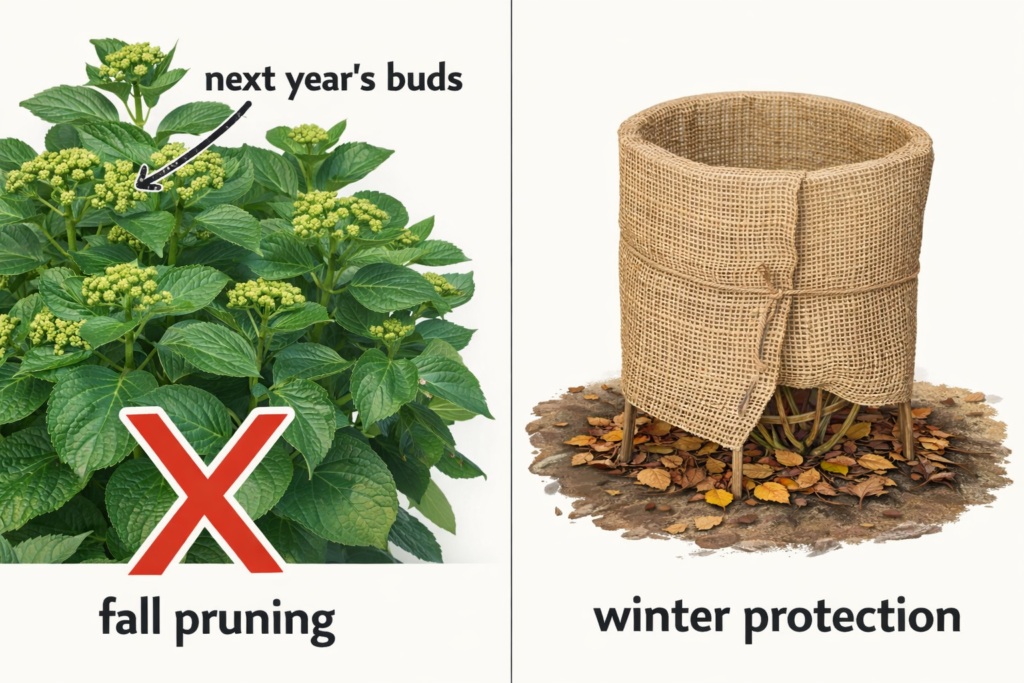
Bigleaf hydrangeas set next year’s buds on stems produced the prior season, so major pruning is typically recommended right after flowering and not late in the year. That timing is emphasized by Clemson HGIC, the Arkansas Cooperative Extension, and summarized in pruning calendars like N.C. Cooperative Extension’s species chart.
- Deadhead (optional): In colder areas, it’s often best to leave spent mophead blooms on over winter for some frost protection, then remove them in early spring by cutting back to the first strong pair of buds—exactly as described by the RHS deadheading guidance and supported by the University of Maryland Extension’s notes on deadheading.
- Reduce size carefully: If you need to shrink the plant, remove some older stems at the base and trim flowering stems back to healthy buds right after bloom; Rutgers describes size reduction by cutting flowering stems back to a pair of healthy buds in FS1152, and Clemson advises pruning soon after flowering and limiting how much you remove in its hydrangea pruning guide.
- Avoid late pruning: Arkansas Extension notes bigleaf hydrangea buds for the next season form after flowering, and recommends finishing pruning by about August to avoid reducing next year’s display inHydrangea Pruning (UAEX); this matches the “after flowering” guidance inN.C. Cooperative Extension’s chart.
Reblooming bigleaf (e.g., Endless Summer-type)
Some cultivars bloom on both old and new wood, which makes them more forgiving if you accidentally prune at the wrong time. The University of Minnesota Extension notes that Endless Summer-series bigleaf hydrangeas bloom on last year’s wood and new wood, and the brand’s own care guidance also emphasizes avoiding cuts that remove healthy green buds in its seasonal pruning tips.
A safe approach:
- In spring, remove only dead tips/stems and keep healthy green buds, per the caution in UMN Extension and Endless Summer’s pruning tips.
- Do shaping right after a flush of bloom if needed, aligning with the broader “after flowering for old-wood types” guidance in RHS and N.C. Cooperative Extension.
Oakleaf (Hydrangea quercifolia)
Oakleaf hydrangea blooms on old wood, so if you prune, do it immediately after flowering (and keep it light). The Missouri Botanical Garden Plant Finder states oakleaf blooms on old wood and should be pruned after flowering if needed, and Clemson HGIC similarly recommends pruning soon after bloom so buds can form for the next year.
- Remove winter-damaged stems in early spring if necessary, as noted by the Missouri Botanical Garden and included in general cleanup advice like Rutgers FS1152.
Climbing hydrangea (Hydrangea anomala subsp. petiolaris)
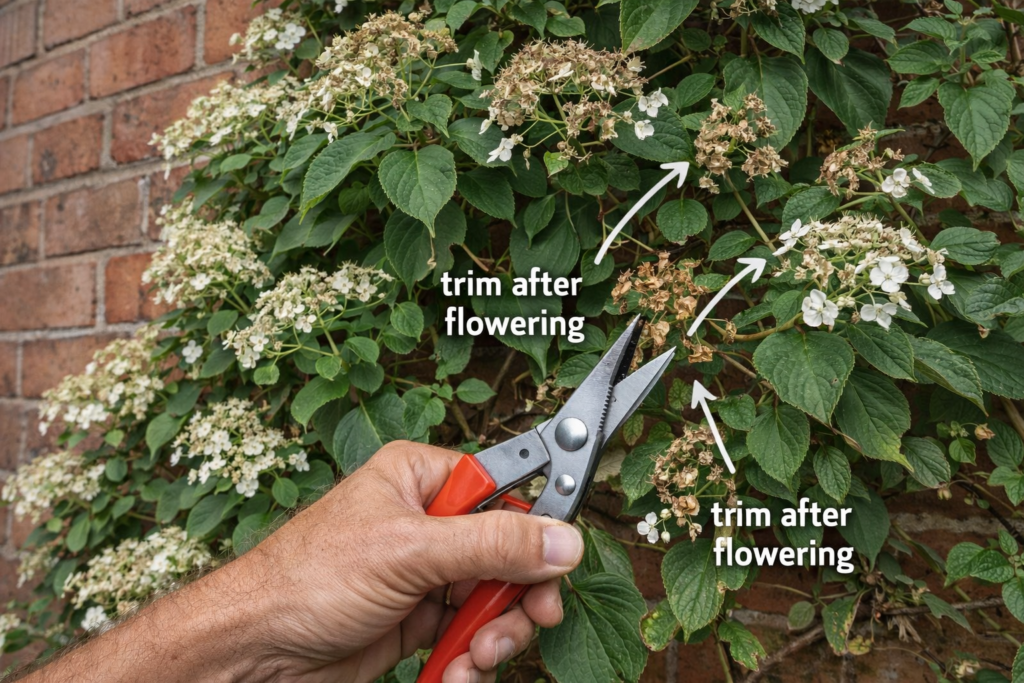
Climbing hydrangeas produce flowers on last year’s shoots, so routine pruning is recommended in summer straight after flowering to preserve next year’s flowering wood. That timing and method are laid out in the RHS climbing hydrangea growing guide and reinforced by the “after flowering (summer)” schedule in N.C. Cooperative Extension’s species chart.
- How to prune: shorten flowered shoots and any overlong new growth, while keeping pruning light (the RHS also notes most flowers form toward the top) in the RHS climbing guide and the general RHS pruning guide.
B) New-wood hydrangeas (prune in late winter/early spring)
Smooth hydrangea (Hydrangea arborescens, including ‘Annabelle’)
Smooth hydrangeas bloom on new growth, so they’re commonly pruned in late winter or early spring. The University of Maryland Extension explicitly recommends this timing and notes smooth hydrangea can be trimmed to about 12 inches; similar cut-back ranges (roughly 6–12 inches) appear in guidance like Alabama Cooperative Extension and the “late winter/early spring” schedule in N.C. Cooperative Extension’s chart.
- Two easy options:
Panicle hydrangea (Hydrangea paniculata)
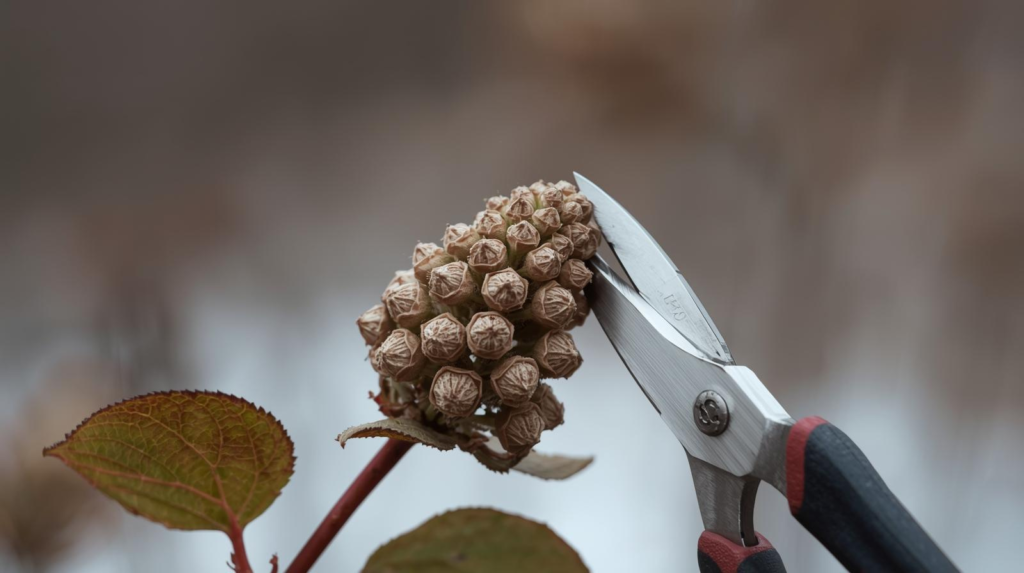
Panicle hydrangeas bloom on new growth and are typically pruned in late winter/early spring, with cuts made just above strong buds. The University of Minnesota Extension describes pruning back to just above a “fat bud” (a heading cut), and the University of Maryland Extension aligns with late winter/early spring timing and notes panicle hydrangeas can be pruned to a similar height as smooth hydrangeas or left taller.
- Practical method: remove a few older stems to open the center, then shorten remaining stems to shape and size—consistent with renewal/thinning approaches described in resources like UMN Extension and UMD Extension.
- If you like winter interest: UMN notes panicle blooms can look good dried through winter, so many gardeners wait until late winter/early spring to prune in its panicle hydrangea section.
Common problems (and the pruning fix)
“My hydrangea didn’t bloom”
Two of the most common causes are (1) pruning an old-wood type at the wrong time (removing buds), and (2) winter/spring cold damage to buds. The “prune after flowering for old wood” rule is emphasized across RHS guidance, Clemson HGIC, and N.C. Cooperative Extension’s pruning schedule.
Try this:
- If it’s bigleaf/oakleaf/climbing: stop fall/winter pruning and prune only after flowering, per RHS and Clemson.
- Consider leaving spent mophead blooms on over winter for some bud protection, as recommended by the RHS deadheading guidance and discussed in the UMD Extension deadheading notes.
- In colder spots, winter protection can help bigleaf buds survive; UNH Extension describes wrapping methods (burlap/chicken wire filled with leaves) in its winter protection post, and OSU notes using frost cloth on frost-prone nights in general hydrangea care guidance.
A simple checklist you can follow every year
- Identify the type using quick cues and a pruning schedule like N.C. Cooperative Extension’s chart and confirm details with a trusted guide such as the RHS pruning guide.
- Do universal cleanup: dead/damaged/weak stems out first (Rutgers FS1152; WSU Extension PDF).
- Old-wood types (bigleaf, oakleaf, climbing): prune after flowering (Clemson; RHS; Missouri Botanical Garden for oakleaf).
- New-wood types (smooth, panicle): prune late winter/early spring (UMD; UMN).