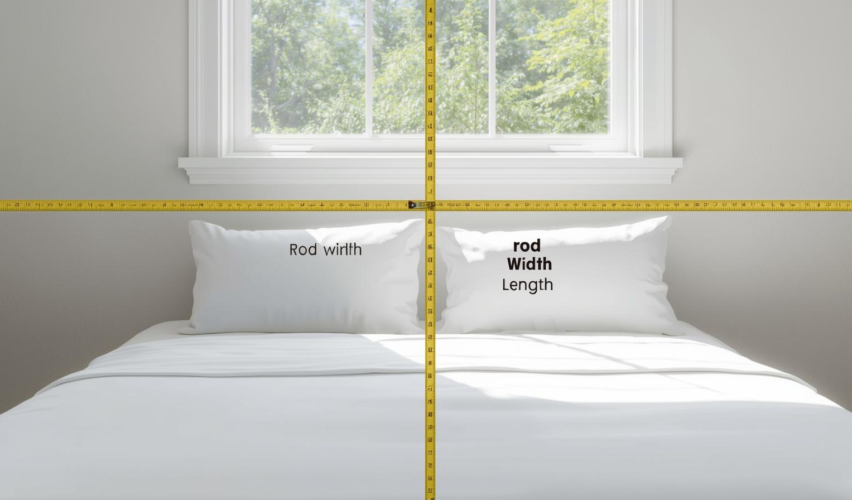
Measuring for curtains comes down to three choices first: where the rod/track will sit (inside vs. outside mount), how “full” you want the curtains to look, and what finished length you want (sill, apron, floor, or puddle)—all of which affect the numbers you write down. Retailer and home-design guides like The Shade Store, Home Depot, and Better Homes & Gardens all follow this same basic logic. (The Shade Store)
What you need
- Tape measure (ideally metal for rigidity)
- Pencil/notes app
- Step stool (optional)
- A helper for tall windows (recommended by Home Depot for keeping the tape straight). (The Home Depot)
Step 1: Decide where the rod/track will go (this sets your measuring points)
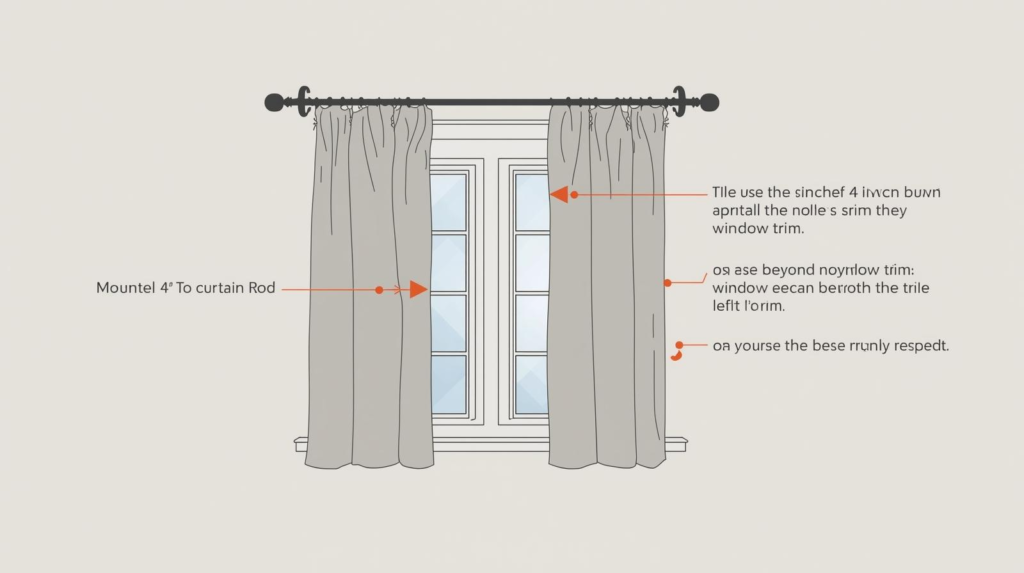
Most “designer” installs are outside mount: the rod sits above and wider than the window to make the window look bigger and to let panels stack off the glass when open. This “hang high and wide” approach is recommended in guides like Martha Stewart, Southern Living, and The Shade Store. (Martha Stewart)
A practical default:
- Height: place the rod about 4–6 inches above the window frame/trim (or higher if you’re going for a taller look), per Martha Stewart and Southern Living. (Martha Stewart)
- Width: extend the rod beyond the window so curtains can open without blocking light; common guidance ranges from about 8–12 inches beyond the window (total extra across both sides) in Better Homes & Gardens to about 12 inches on each side in The Shade Store. (Better Homes & Gardens)
- If you need a tighter install (radiator, narrow wall), a simpler rule is adding at least ~6 inches per side, which matches IKEA’s “add at least 15 cm on each side” (15 cm ≈ 5.9 in) guidance in IKEA’s measuring tips. (IKEA)
Step 2: Measure the width you want to cover (then add fullness)
2A) Measure your “coverage width”
For outside mount curtains, measure the planned rod length (or the width you want the curtains to span), not just the glass. This matches measurement advice from The Shade Store and Home Depot. (The Shade Store)
Write down:
- Rod (or track) length = your coverage width.
2B) Convert coverage width into “total curtain panel width” (fullness)
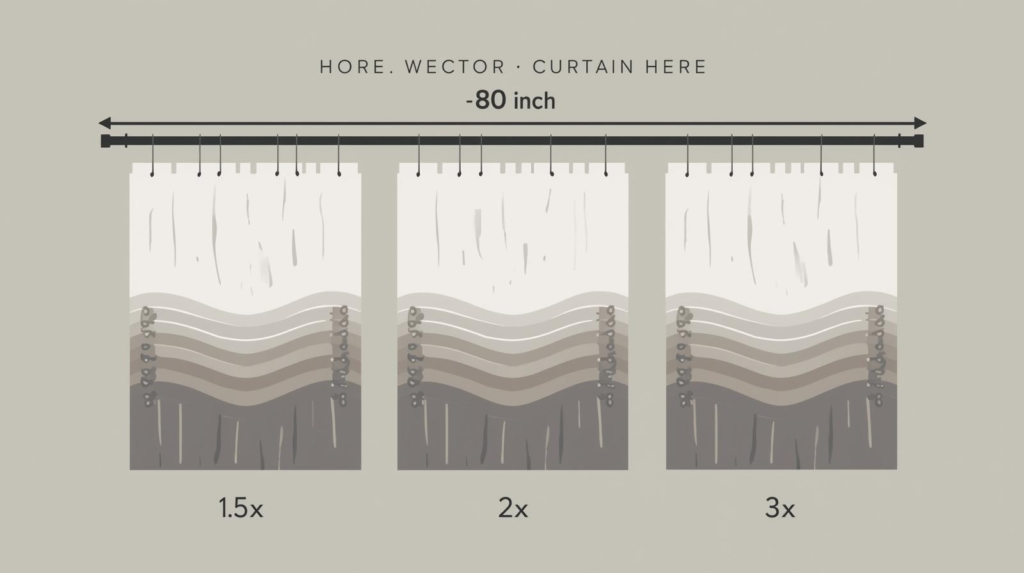
Curtains look best when they’re wider than the rod/track span, creating pleats/waves. A common rule is 1.5× to 2× the coverage width for most fabrics, per The Shade Store’s measuring steps and IKEA’s pleat/fullness guidance. (The Shade Store)
Use this quick guide:
- Lightly full (modern): 1.5× rod/coverage width (suggested by The Shade Store and reflected in IKEA’s single-pleat range). (The Shade Store)
- Standard full: ~2× (a widely used baseline noted by Better Homes & Gardens and The Shade Store). (Better Homes & Gardens)
- Extra full (sheers or luxe look): 2.5×–3× is often recommended for thin sheers in custom guides like The Shade Store. (The Shade Store)
Example (easy math): If your rod will span 80 inches and you want standard fullness (2×), you want 160 inches total panel width (e.g., two 80-inch panels, or four 40-inch panels).
Step 3: Choose your finished curtain length (then measure from the right spot)
Home improvement guides typically tell you to measure from where the hardware will sit down to your intended end point (sill, apron, floor, puddle), as described by Home Depot and curtain-length guides like Martha Stewart. (The Home Depot)
Pick a length style
- Sill length: ends at (or just around) the window sill—common for kitchens/baths (length categories are summarized in measurement guides like Home Depot and style guides like Homes & Gardens). (The Home Depot)
- Apron length: hangs below the sill (often used when floor-length would hit furniture or radiators), described in style references like Homes & Gardens and many curtain length charts. (Homes and Gardens)
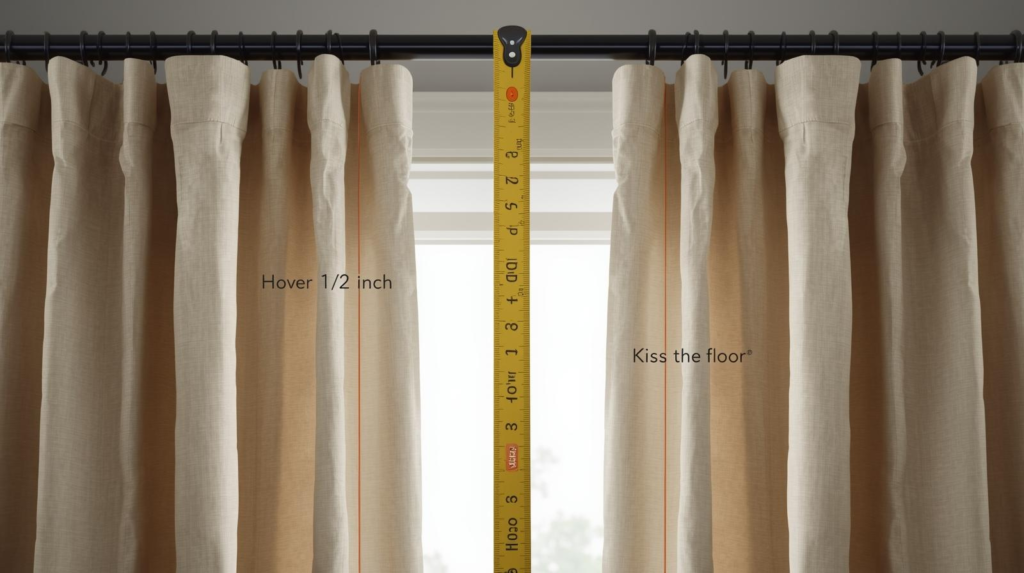
- Floor length (most popular): hem “kisses” the floor or hovers slightly above it; clean looks like a small hover are described in guides like Crate & Barrel and “professional” hanging advice like Southern Living. (Crate & Barrel)
- Puddle: fabric intentionally pools on the floor; for puddling, you add extra inches to your floor measurement (examples include Home Depot’s puddle add-on guidance and length-rule breakdowns like Kwik-Hang’s guide). (The Home Depot)
Measure the length (the “start point” depends on how the curtain hangs)
Use the method that matches your header style:
- Grommets or rod pocket: measure from the top of the rod down to your desired end point (this “measure from the rod” approach is how Home Depot frames length for decorative/outside-mount rods). (The Home Depot)
- Rings with hooks/pins: measure from the eye of the ring (or where the hook sits) down to the end point; many hanging guides remind you hardware affects finished length, including installation-focused resources like The Shade Store. (The Shade Store)
- Clip rings: measure from the bottom of the clip down to the end point (because the clip adds drop). (This is a practical extension of “measure from the hanging point,” consistent with how-to hanging guides like Better Homes & Gardens discuss choosing hardware and measuring before purchase.) (Better Homes & Gardens)
Puddle math (quick): If you want puddling, measure to the floor, then add extra inches—Home Depot suggests adding about 3–6 inches depending on how dramatic you want it, and Kwik-Hang breaks puddle styles into small ranges like “minimal” and “moderate.” (The Home Depot)
Step 4: Double-check for real-world walls (so you don’t buy the wrong size)
- Measure in 3 places (left, center, right) if your floors or windows might be uneven, then use the measurement that matches the look you want (many measurement guides emphasize accuracy and measuring from the intended install point, like IKEA’s steps and Home Depot). (IKEA Indonesia)
- Don’t include finials when measuring a rod span (only the usable rod/track length), as noted in buying guides like B&M’s curtain measuring guide. (B&M Stores)
- Plan for stacking space: wider rod placement helps keep panels off the glass when open, which is a key reason “wide” installs are recommended in guides like The Shade Store and Better Homes & Gardens. (The Shade Store)
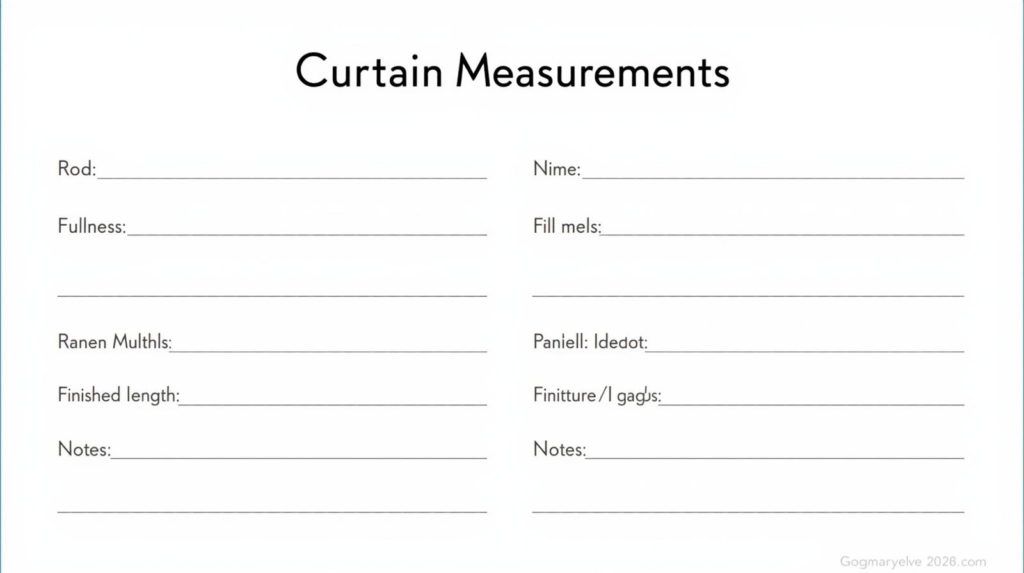
Quick “write-this-down” template
For each window, record:
- Rod/track type: rod or track, inside or outside mount (setup logic: IKEA measuring steps) (IKEA Indonesia)
- Rod/track span (coverage width): ____ inches
- Fullness multiplier (1.5× / 2× / 3×): ____ (fullness rules: The Shade Store, IKEA pleat guidance) (The Shade Store)
- Total panel width needed: coverage × fullness = ____ inches
- Finished length style: sill / apron / floor / puddle (length options: Home Depot, Homes & Gardens) (The Home Depot)
- Measured length (from the correct hanging point): ____ inches
Summary
To measure for curtains: set your rod placement first (high and wide is common), measure the rod/coverage width, multiply by a fullness factor (often 1.5×–2×), then measure length from the correct hanging point to your desired finish (floor, hover, or puddle) using guidance like Home Depot, The Shade Store, and IKEA. (The Home Depot)